Your wedding day should be a celebration of love, not a scramble to fix preventable issues. Yet every year, countless couples face avoidable stress because they overlooked simple verification steps in the final days before their event. Last Minute Problems in Wedding Halls can transform a dream celebration into a logistical nightmare, affecting everything from guest comfort to vendor performance and overall event flow.
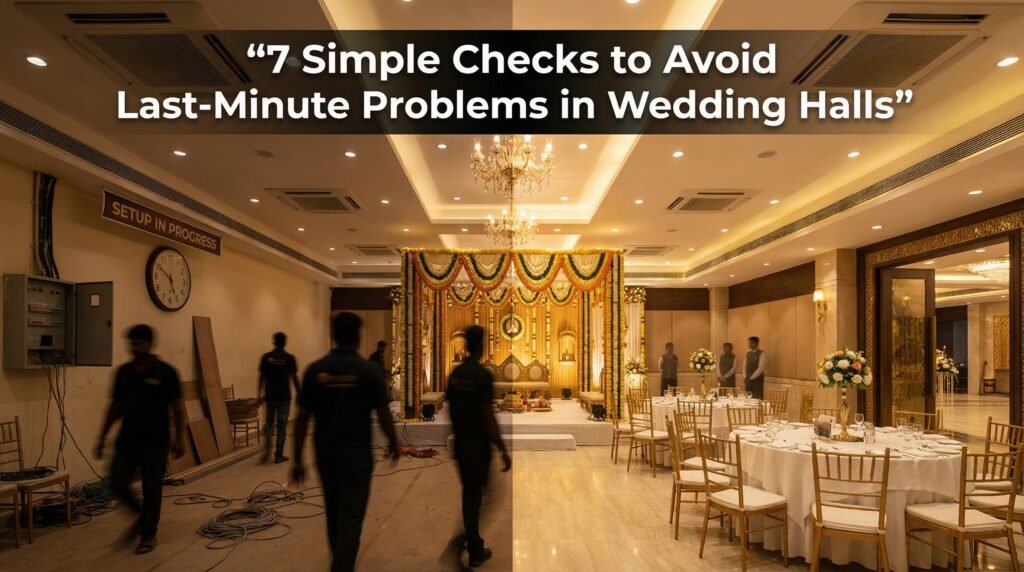
The good news? Most complications arise from a handful of common oversights that take minimal time to address. Whether you’re planning an intimate gathering or a grand celebration, conducting thorough pre-event checks protects your investment and preserves the joy of your special day. At venues like Raj Wedding hall, experienced coordinators emphasize that prevention beats reaction every time. A few hours of verification in the week leading up to your wedding can save you from equipment failures, timing confusion, safety concerns, and coordination breakdowns.
This guide walks you through seven essential checks that wedding planners and venue managers recommend to every couple. These aren’t complicated audits requiring technical expertise—they’re straightforward verifications any couple can complete with their venue coordinator. Each check addresses a specific category of Last Minute Problems in Wedding Halls that experienced event professionals encounter repeatedly. By following these steps, you’ll arrive on your wedding day confident that every detail has been confirmed, every vendor is synchronized, and every backup plan is in place.
Why Small Checks Matter More Than You Think
Wedding venues host dozens or hundreds of events annually, creating a false sense of security. Couples often assume that because a hall regularly hosts weddings, nothing can go wrong. This assumption underlies most Last Minute Problems in Wedding Halls. The reality is that each wedding combines unique vendors, specific timing requirements, custom technical setups, and individual guest needs that create countless opportunities for miscommunication.
Consider the financial and emotional stakes. The average wedding represents months of planning and significant financial investment. A single overlooked detail—an unchecked microphone, an unconfirmed vendor arrival time, or an untested backup generator—can cascade into major disruptions. These checks also protect vendor relationships and venue reputation. When coordination breaks down, determining responsibility becomes difficult, and your special moments may be lost to troubleshooting.
The verification process also builds confidence. Walking through these checks with your venue coordinator and vendors creates clarity about roles, responsibilities, and timing. You’ll identify potential conflicts before they become emergencies, establish communication protocols for the event day, and ensure everyone shares the same expectations. This preparation transforms anxiety into assurance, allowing you to focus on celebrating rather than managing logistics.
1. Walkthrough and Layout Verification
Physical space issues represent some of the most common Last Minute Problems in Wedding Halls. Floor plans created months in advance may not account for recent renovations, seasonal decorations, or furniture configurations. A comprehensive venue walkthrough one week before your wedding and again 24-48 hours prior confirms that reality matches expectations.
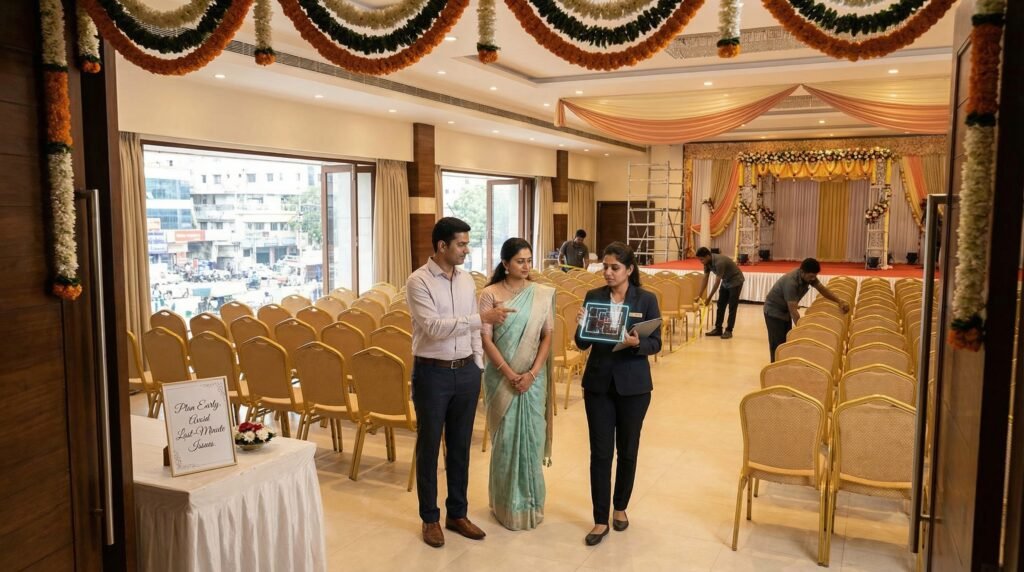
Complete Walkthrough Checklist:
- Walk the exact path guests will take from entry to ceremony space to reception area
- Verify all emergency exits are clearly marked, accessible, and not blocked by decorations
- Check that accessibility features (ramps, elevators, accessible restrooms) function properly
- Confirm table and chair counts match your final guest list with 5-10% buffer seating
- Measure aisle widths for procession, ensuring adequate space for dresses and movement
- Identify tripping hazards such as loose carpeting, extension cords, or threshold transitions
- Verify climate control zones work in all areas guests will occupy
- Confirm that your floor plan accommodates vendor equipment (DJ booth, photo backdrop, gift table)
Real-world example: A couple discovered during their final walkthrough that a recently installed decorative partition reduced their dance floor by 30%. Catching this issue three days early allowed the venue to reconfigure the space rather than surprising 150 guests with a cramped reception. This prevented one of the common Last Minute Problems in Wedding Halls related to spatial planning.
Quick-tip printable: Create a simple floor plan sketch during your walkthrough, marking electrical outlets, light switches, emergency exits, and restroom locations. Share this annotated map with all vendors so everyone works from the same spatial reference.
2. Final Vendor Confirmations and Timeline Sync
Vendor coordination failures generate the majority of Last Minute Problems in Wedding Halls. Even with signed contracts, vendors may have scheduling conflicts, equipment changes, or staff adjustments that weren’t communicated. A wedding venue checklist isn’t complete without systematic vendor verification 72 hours before your event.
Vendor Confirmation Protocol:
- Call (don’t email) each vendor to confirm arrival time, setup duration, and contact person name
- Verify the specific equipment each vendor is bringing (not just assuming contract terms)
- Confirm vendor load-in access points, parking locations, and setup time windows
- Review your wedding day timeline together, identifying any scheduling conflicts between vendors
- Establish a primary contact person who holds authority to make day-of decisions
- Request each vendor’s backup plan for equipment failure or personnel emergencies
- Confirm final guest count with caterer and adjust food quantities if numbers changed
- Verify that all vendors have the venue’s layout and understand space limitations
Real-world example: A DJ discovered during a confirmation call that his new lighting rig required three additional power outlets. Because this conversation happened five days early rather than upon arrival, the venue arranged appropriate power distribution, preventing setup delays and Last Minute Problems in Wedding Halls.
Quick-tip printable: Create a single-page vendor contact sheet listing each vendor’s name, arrival time, phone number, and setup requirements. Print copies for yourself, your venue coordinator, and your wedding party point person.
3. Power, Lighting, and Backup Systems
Technical failures rank among the most disruptive Last Minute Problems in Wedding Halls. Modern weddings depend heavily on electricity for lighting, sound systems, catering equipment, climate control, and entertainment. Yet couples rarely verify that venues can deliver adequate power for their specific event configuration.
Power and Technical Systems Checklist:
- Calculate total power draw from all vendors (DJ, caterer, photographer, decorator) and verify against venue capacity
- Test all lighting systems including house lights, accent lighting, emergency lighting, and dimmer switches
- Confirm backup power for events exists and covers critical systems (not just emergency lighting)
- Verify that generators are serviced, fueled, and tested within the past month
- Check that all electrical panels are accessible and that the venue team knows how to reset breakers
- Test sound system power sources separately from lighting to prevent circuit overload
- Identify which outlets share circuits to prevent accidental overload during the event
- Confirm that outdoor lighting (if applicable) functions and that extension cords are weatherproof and properly rated
Real-world example: During a venue walkthrough, a couple requested that their coordinator demonstrate the backup generator. The test revealed a fuel line issue that would have caused generator failure within 20 minutes. Repairing this problem eliminated a potential source of Last Minute Problems in Wedding Halls that could have shut down their entire reception.
Quick-tip printable: Ask your venue for a simple power map showing which outlets connect to which circuits. Share this with your DJ and caterer so they can distribute their equipment load appropriately.
4. Food Safety and Serving Logistics
Catering complications create both health risks and timing disasters. Food service involves intricate coordination between kitchen staff, servers, and event timeline. Many Last Minute Problems in Wedding Halls stem from unclear communication about meal service logistics.
Food Service Verification Steps:
- Confirm final guest count including meal preferences (vegetarian, vegan, allergies) with specific numbers
- Verify food holding temperatures and reheating capabilities match food safety standards
- Review the exact serving timeline including cocktail hour, first course, main course, and dessert
- Confirm that serving staff count is adequate for your guest count (typically 1 server per 15-20 guests)
- Check that all food allergy labels or table markers are prepared and accurate
- Verify adequate refrigeration for perishables and heated holding for hot dishes
- Confirm bar setup completion time and verify ice quantities for your guest count
- Review cleanup timeline to ensure food service areas remain sanitary throughout the event
Real-world example: A coordinator discovered that the couple’s chosen multicourse timeline conflicted with the caterer’s staffing plan. Addressing this four days early prevented a situation where appetizers would have been cleared before half the guests received them—a common source of Last Minute Problems in Wedding Halls.
Quick-tip printable: Create a meal service timeline that marks specific clock times (not just “after ceremony”) for each food service phase. This prevents the vague timing that causes service delays.
5. Guest Logistics and Signage
Guest experience problems often go unnoticed until people begin arriving. Parking confusion, unclear entrances, missing directional signs, and restroom location mysteries create the kind of Last Minute Problems in Wedding Halls that affect everyone’s experience simultaneously.
Guest Flow and Logistics Checklist:
- Walk the complete guest arrival path from parking area to venue entrance
- Verify that parking capacity matches guest count with consideration for vendor and staff vehicles
- Confirm that directional signage is visible, weatherproof, and placed at every decision point
- Check that restroom signage is clear and that facilities are stocked with supplies
- Verify coat check or gift table placement doesn’t create entry bottlenecks
- Confirm that elderly guests and those with mobility challenges have accessible parking and entrance routes
- Test the guest check-in or seating chart visibility and placement
- Verify that late-arriving guests can locate the event without disrupting the ceremony
Real-world example: A couple’s venue walkthrough revealed that their ceremony space entrance was visible from three different doors. Without clear signage, guests would inevitably choose the wrong entrance and walk through the ceremony in progress. Adding simple directional signs prevented this foreseeable instance of Last Minute Problems in Wedding Halls.
Quick-tip printable: Stand at your venue’s parking lot and imagine you’ve never been there before. What signs would you need to find the correct entrance? Create signage that answers every question a confused guest might have.
6. AV, Microphone Checks, and Rehearsal Run
Audio-visual failures create some of the most memorable Last Minute Problems in Wedding Halls. A microphone that cuts out during vows, a playlist that won’t play, or a projector that displays the wrong aspect ratio can’t be fixed quickly once the ceremony begins.
Complete AV Verification Protocol:
- Conduct full sound check with actual ceremony participants speaking at ceremony volume levels
- Test all microphones (officiant, readers, vocalists) in their actual ceremony positions
- Verify that speakers provide even coverage throughout the ceremony space with no dead zones
- Test music playback from your actual playlist using the venue’s system
- Confirm that wireless microphone batteries are fresh and that backup batteries are available
- Verify that all audio cables are secured and won’t create tripping hazards
- Test any video projection equipment with actual content at the time of day your event occurs (ambient light matters)
- Conduct a complete ceremony rehearsal using the actual AV setup, not a verbal walk-through
Real-world example: During an AV check, a couple discovered that their string quartet’s amplification system created feedback when positioned near the venue’s house speakers. Identifying this technical conflict early allowed for speaker repositioning, preventing the kind of Last Minute Problems in Wedding Halls that can ruin ceremony videos.
Quick-tip printable: Record a short video during your sound check from several positions in the ceremony space. Review this recording to verify audio clarity from every angle where guests will sit.
7. Emergency Plan and On-Site Contact List
Crisis preparation often gets dismissed as pessimistic, yet having clear emergency protocols prevents chaos when unexpected situations arise. Many Last Minute Problems in Wedding Halls escalate because no one knows who to contact or what procedures to follow.
Emergency Preparedness Checklist:
- Identify the venue’s designated emergency coordinator and verify their contact information
- Locate first aid kits, AEDs, and fire extinguishers with your venue team
- Confirm that venue staff know how to contact local emergency services and that addresses are correct
- Establish a weather backup plan with specific trigger points for implementation
- Create a contact list including venue manager, vendors, wedding party, and emergency services
- Designate specific individuals to handle specific crisis categories (medical, vendor no-show, weather, guest conflicts)
- Verify that the venue carries current liability insurance and that you have certificate copies
- Confirm that venue security or staff will remain on-site for your entire event duration
Real-world example: A sudden severe weather alert arrived three hours before a ceremony. Because the couple had established weather trigger points and backup plans during their venue emergency planning session, they executed an indoor transition smoothly. This preparation prevented the panic and Last Minute Problems in Wedding Halls that weather emergencies typically create.
Quick-tip printable: Create a laminated emergency contact card for your coordinator, best man, and maid of honor. Include venue manager, your phones, key vendor contacts, and local emergency numbers.
Day-of Timeline Sample and Checklist
A clear wedding day timeline transforms abstract planning into concrete action steps. This sample timeline helps prevent Last Minute Problems in Wedding Halls by establishing realistic timeframes for each wedding phase.
Sample Wedding Day Timeline:
- 8 hours before ceremony: Venue access opens for decorator and setup crew
- 6 hours before ceremony: Caterer arrives and begins kitchen setup
- 4 hours before ceremony: Florist completes ceremony and reception décor installation
- 3 hours before ceremony: AV team completes equipment setup and conducts sound checks
- 2 hours before ceremony: Final venue walkthrough with coordinator checking all stations
- 90 minutes before ceremony: Wedding party arrives for photos and final preparations
- 60 minutes before ceremony: Guest parking areas open and ushers take positions
- 30 minutes before ceremony: Ceremony music begins and guests are seated
- Ceremony start: Processional begins at scheduled time regardless of arrival delays
- Immediately post-ceremony: Cocktail hour begins while ceremony space transitions
- 60 minutes post-ceremony: Guests move to reception space for dinner service
- 90 minutes post-ceremony: First course service begins
- 3 hours post-ceremony: Dancing portion and evening entertainment begin
- Event conclusion: Final vendor breakdown and venue walkthrough
This detailed timeline prevents the timing ambiguity that creates vendor coordination problems and guest confusion.
Vendor and Contract Review Checklist
Contract clarity prevents disputes and establishes accountability. One week before your wedding, conduct a final contract review focusing on elements that generate Last Minute Problems in Wedding Halls when misunderstood.
Critical Contract Verification Points:
- Confirm liability insurance coverage amounts and verify that certificates are current and name your venue
- Review cancellation and postponement clauses including refund schedules and rebooking options
- Verify overtime costs and procedures for extending beyond contracted hours
- Confirm damage deposit terms including refund timeline and condition documentation requirements
- Review final payment schedules ensuring you know exactly when and how final payments are due
- Verify that menu selections, rental quantities, and service staff counts match your actual needs
- Confirm that all special requests and customizations are documented in writing
- Review force majeure clauses that address weather emergencies and unforeseen circumstances
Many couples discover contract discrepancies only when invoicing begins. Conducting this review while time remains to address issues prevents payment disputes and service confusion that constitute financial Last Minute Problems in Wedding Halls.
Troubleshooting Quick-Fixes
Despite thorough preparation, minor issues sometimes arise. Having immediate solutions for common problems prevents small hiccups from becoming major Last Minute Problems in Wedding Halls.
Common Issues and Fast Solutions:
- Power fluctuation: Identify circuit breaker locations and keep a venue staff member with access on-site throughout your event
- Late vendor arrival: Maintain a 30-minute setup buffer in your timeline and have backup contact numbers for vendor management teams
- Food service delay: Build 15-minute flexibility into your meal timeline and prepare additional cocktail hour activities if needed
- Missing rental items: Keep your rental company’s after-hours contact number and maintain an inventory checklist for verification
- Climate control problems: Know thermostat locations and acceptable temperature ranges, adjusting 30 minutes before guests arrive
- Microphone battery failure: Always maintain backup batteries and test wireless equipment 30 minutes before use
These quick-fix protocols transform potential crises into minor adjustments, maintaining event flow and guest experience.
Conclusion: Prevention Beats Reaction Every Time
Last Minute Problems in Wedding Halls are almost always preventable. The seven checks outlined in this guide require just a few hours of verification time but deliver immeasurable peace of mind. By systematically confirming physical space, vendor coordination, technical systems, food service, guest logistics, AV equipment, and emergency protocols, you eliminate the common failure points that disrupt weddings.
Remember that your venue partnership matters tremendously in this process. Professional venues like Raj Wedding hall understand that thorough preparation protects everyone involved—the couple, the guests, the vendors, and the venue itself. Schedule your verification walkthroughs, conduct your vendor confirmations, test your systems, and document your plans. When your wedding day arrives, you’ll celebrate knowing that every preventable issue has been addressed.
Don’t let avoidable Last Minute Problems in Wedding Halls compromise your celebration. Contact our coordination team today to schedule your comprehensive venue verification appointments and ensure your special day unfolds exactly as planned.
Frequently Asked Questions(FAQ)
Q: How early should I schedule my final venue walkthrough to avoid Last Minute Problems in Wedding Halls?
A: Schedule your detailed walkthrough 7-10 days before your wedding, then conduct a brief verification 24-48 hours prior. This timeline allows you to address issues while vendors and venue staff have time to implement solutions without rushing.
Q: What’s the most commonly overlooked check that causes wedding day problems?
A: Vendor timeline synchronization causes frequent issues. Couples often assume vendors coordinate automatically, but without explicit timeline confirmation calls, vendors may arrive late, overlap setup times, or misunderstand their service windows, creating preventable Last Minute Problems in Wedding Halls.
Q: Should I hire a day-of coordinator even if my venue provides coordination services?
A: Venue coordinators manage facility logistics, while day-of coordinators manage your specific event flow and vendor relationships. For complex weddings with multiple vendors, an independent coordinator provides additional oversight that prevents coordination breakdowns and timing issues.
Q: How can I verify my venue’s backup power actually works?
A: Request a demonstrated generator test during your walkthrough. Watch the generator start, verify it powers critical systems, and confirm it runs smoothly for at least 15 minutes. This simple test exposes maintenance issues that could cause Last Minute Problems in Wedding Halls during your event.
Q: What items should I include in my emergency contact list?
A: Your emergency contact list should include venue manager and facility staff, all vendor primary contacts and after-hours numbers, wedding party members with assigned responsibilities, your coordinator, local emergency services, and nearby hospitals. Distribute this list to at least three responsible individuals.
Q: How many days before my wedding should I finalize my vendor confirmations?
A: Conduct phone confirmations with each vendor exactly 72 hours (three days) before your wedding. This timing is recent enough that vendors have accurate information but early enough that you can address any conflicts, equipment changes, or scheduling issues that emerge.